Home › Ash Tree Removal
Ash tree removal in Greeley, CO
Safe removal of ash killed or weakened by emerald ash borer, before the wood turns brittle.
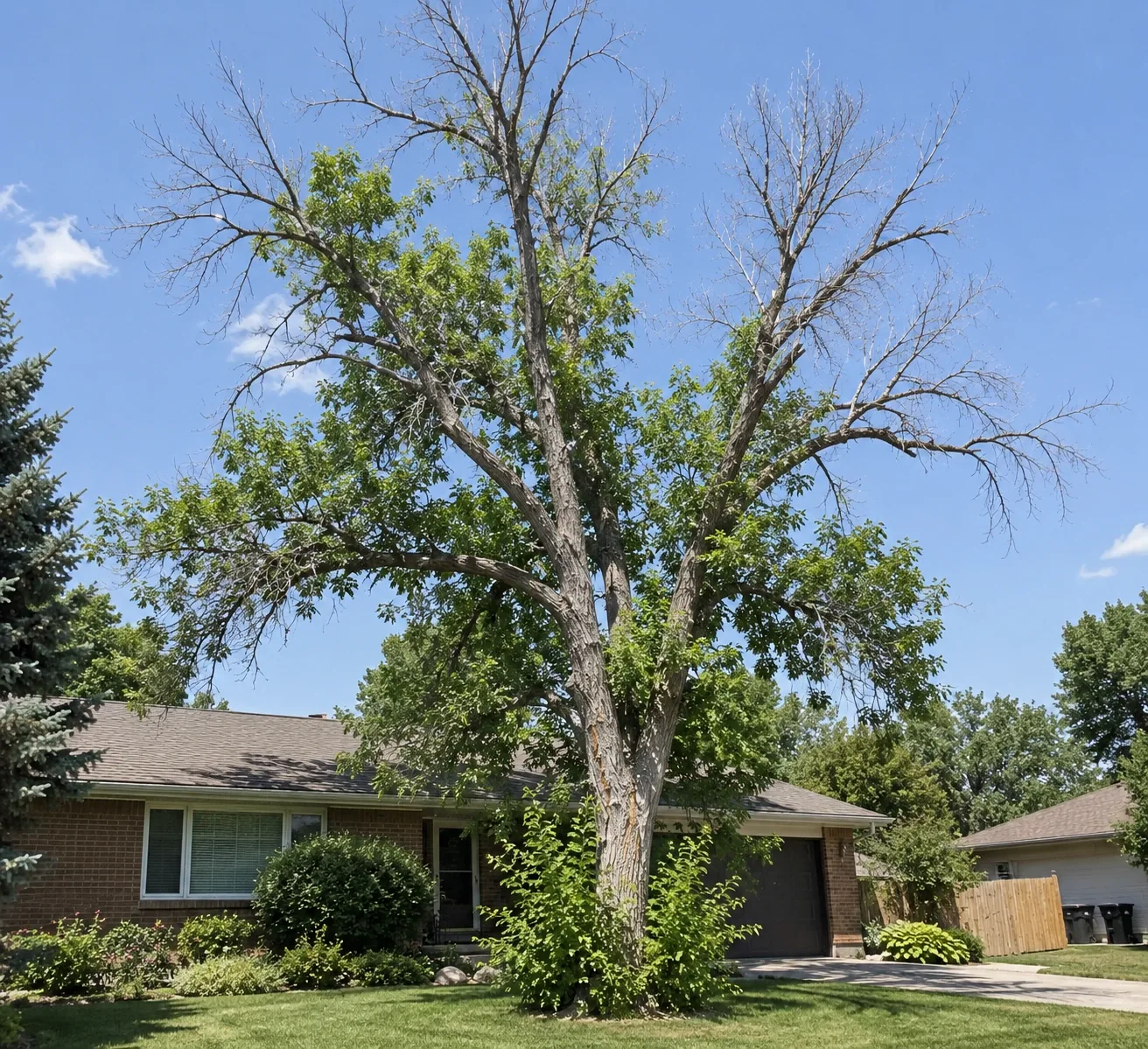
Why ash removal is its own job
Removing an ash killed by emerald ash borer is not the same work as removing a healthy tree of the same size, and any contractor quoting it identically has not thought about it properly.
EAB-killed ash becomes exceptionally brittle. The wood loses its fibrous strength and starts behaving more like dry kindling than hardwood. Limbs snap under a climber's weight that would hold a person easily on a live tree, and they fail with none of the creaking warning a decaying maple gives you.
That changes the method. Dead ash frequently cannot be climbed at all, which means an aerial lift or a crane, which costs more. It is one of the few situations where waiting genuinely costs you money rather than saving it.
Remove it early
The cheapest time to remove an infested ash is while it still has enough sound wood to climb. Every season it stands adds risk, adds equipment, and adds cost. A tree that could have been taken down conventionally in year one may need a lift in year three and a crane in year five.
It also becomes a liability question. Property owners are generally responsible for hazardous trees on their land, and a dead ash over a sidewalk, driveway or neighbour's fence is about as clear a hazard as exists.
What happens to the wood
There is no longer a federal or Colorado EAB quarantine. The federal domestic quarantine was withdrawn effective January 2021, and Colorado's Boulder County quarantine was repealed at the end of 2019.
The regulation went away; the risk did not. Moving infested ash firewood remains the fastest way this beetle travels, and state foresters cite firewood movement as the likely reason EAB turned up in Carbondale in 2023, far from any other detection. The practical rule is simple: keep ash wood local, and do not take it to a cabin or campsite.
Is it definitely ash, and is it definitely EAB?
Before anything comes down, it is worth confirming both. Ash has opposite branching, compound leaves with five to nine leaflets, and diamond-patterned bark on mature trunks. Mountain ash is a different genus entirely and is not affected.
For confirming EAB rather than another problem, see our full guide to identifying emerald ash borer damage. Some declining ash in Greeley is dealing with drought stress, root damage or ash yellows instead, and the treatment path is different.
What comes next
Most people removing an ash want something back in the space. The mistake is replacing it with another single species that a future pest can take out just as comprehensively. Greeley learned this with elm before ash, and is learning it again now.
Good replacements for Weld County conditions include Kentucky coffeetree, hackberry, bur oak, Northern catalpa and honeylocust — all tolerant of alkaline soil and plains wind. We can plant it or just tell you what to ask for at the nursery.
Questions we get about this
Why is removing a dead ash more expensive than a live tree?
Because it usually cannot be climbed. EAB-killed ash goes brittle and limbs fail without warning under a climber's weight, so the job often requires an aerial lift or a crane. Removing the tree earlier, while it still has sound wood, is materially cheaper.
Can I keep the wood?
On your own property, yes. Keep it there. There is no longer a Colorado or federal EAB quarantine, but transporting ash firewood is still the main way this beetle covers long distances, so the wood should not travel.
My ash still has leaves. Do I have to remove it?
Not necessarily. An ash that has lost less than about a third of its canopy and is otherwise sound may be a candidate for treatment. Past that point, removal is usually the better use of the money.
How long can I leave a dead ash standing?
Longer than you should. It gets more brittle, more dangerous and more expensive to remove every season, and in the meantime it is a falling hazard you are liable for.
What should I plant instead?
Something other than ash, and ideally not whatever your neighbours are all planting either. Kentucky coffeetree, hackberry, bur oak, Northern catalpa and honeylocust all handle Greeley's alkaline soil and wind.