Home › Ash Borer
Emerald ash borer in Greeley, CO: what ash tree owners should know
How to tell whether your ash is infested, and what Greeley property owners should do about it.
Where EAB stands in Greeley
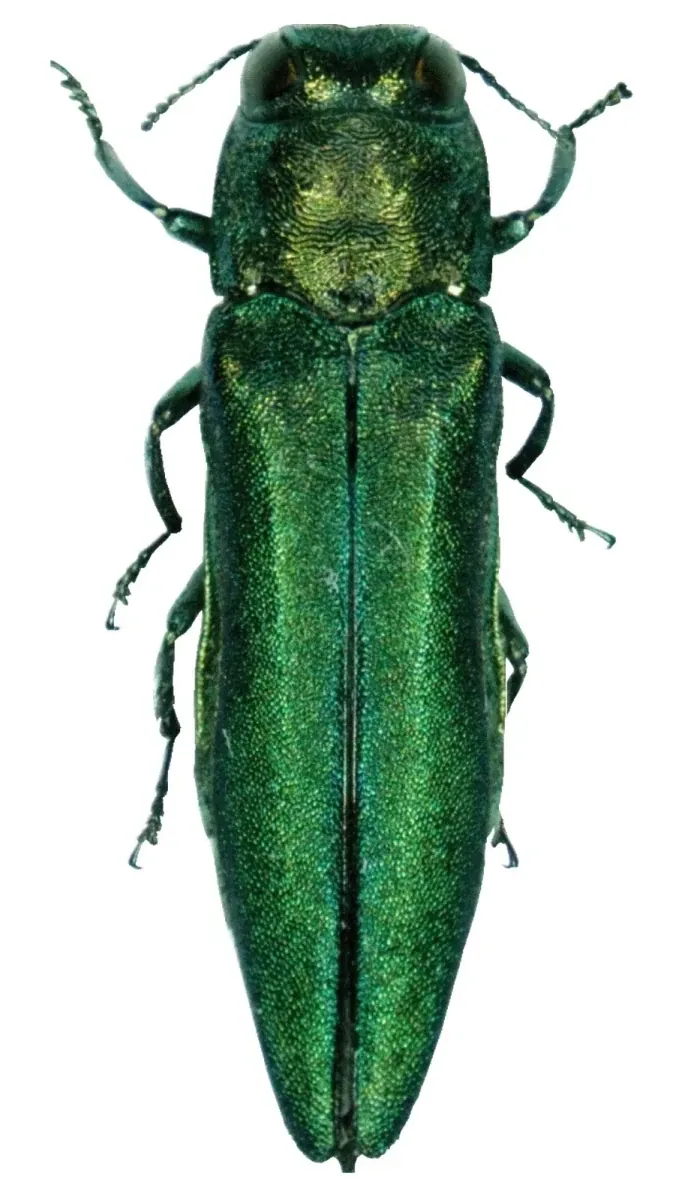
Emerald ash borer has spread throughout Colorado's Front Range and has been confirmed in communities surrounding Greeley. The City of Greeley's published forestry guidance states that the pest has not been found in Greeley itself, while noting that experts confirmed EAB near the Town of Berthoud in Larimer County. The City's own framing is that it is not a matter of if the beetle appears in Greeley, but when.
Statewide, the picture has moved quickly. The Colorado State Forest Service reported in October 2025 that EAB had been detected in more than 20 Front Range cities, with confirmations that year alone in Aurora, Berthoud, Denver, Edgewater, Golden and Wheat Ridge. Their guidance to residents is direct: Front Range residents should assume the pest is in their city or town.
That matters here because ash makes up approximately 15% of Greeley's canopy, and the City owns only about 5% of those ash trees. The rest belong to private property owners, which means most of the decisions about Greeley's ash will be made by homeowners rather than by the City.
There is no longer an EAB quarantine. There is no longer a federal or Colorado EAB quarantine. The federal domestic quarantine regulations were withdrawn effective January 2021, and Colorado's Boulder County quarantine was repealed at the end of 2019. No permit is needed to move ash wood — but moving infested firewood is still the fastest way this beetle travels, and state foresters point to it as the likely reason EAB turned up in Carbondale in 2023, far from any other detection. Burn ash wood where it was cut.
How to tell if your ash is infested
Work top to bottom. No single sign is conclusive on its own; two or more together on an ash is worth an inspection.
Canopy dieback, starting at the top
Usually the first thing anyone notices. Bare branches in the upper third of the crown while the lower canopy still leafs out. The larvae feed just under the bark and sever the tissue that moves water and sugars, so the top — furthest from the roots — starves first.
Sprouts from the trunk and base
Vigorous shoots erupting from the lower trunk or root flare. The tree is attempting to push growth below the damage. On an ash, it is a bad sign.
Woodpecker damage
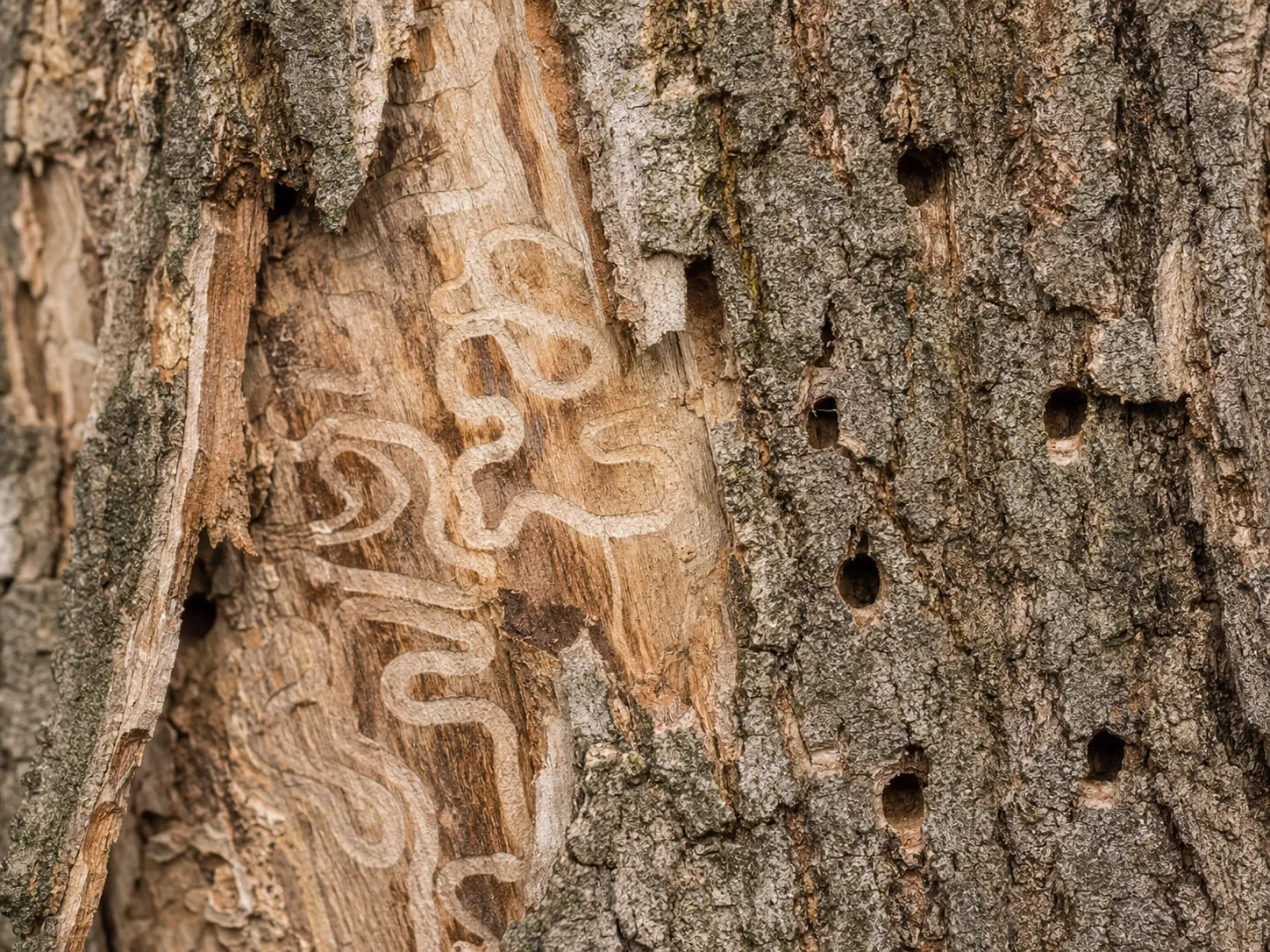
Heavy bark flaking and irregular holes on the upper trunk and limbs, sometimes called blonding because it exposes pale wood underneath. Woodpeckers find the larvae before people do, and unusual woodpecker attention on an ash is one of the most reliable early indicators there is.
D-shaped exit holes
Adult beetles chew out through the bark leaving a distinctive hole about an eighth of an inch across, flat on one side. Round holes are a different insect. Easy to miss, because they are small and often high up.
S-shaped galleries under the bark
Peel back a section of loose bark and you will see winding, serpentine tunnels packed with fine sawdust. This is definitive. If you can see these, the tree is infested.
More detail on each of these signs: signs of emerald ash borer.
First, make sure it is an ash. Ash has opposite branching, compound leaves with five to nine leaflets, and diamond-patterned bark on mature trunks. Mountain ash is not a true ash and is not affected. See how to identify an ash tree.
Treatment or removal
This is the decision most Greeley property owners find hardest, and the answer depends on the specific tree rather than on a rule.
Treatment can work on a healthy, structurally sound ash that has lost less than about a third of its canopy. Systemic insecticide applied by a licensed applicator, repeated on a cycle, protects a tree as long as treatment continues. It is a long-term commitment and a long-term cost.
Removal is usually the better answer when canopy loss is past roughly a third, when the tree has structural defects independent of the borer, or when the tree is small enough that replacement makes more sense than decades of treatment. It is also the right call if the treatment programme will not realistically be maintained, because a lapsed programme ends the same way as no treatment.
Worked through in full, including how the costs compare over time: treatment vs removal.
Greeley's residential ash treatment program
The City of Greeley has run a Residential Ash Treatment Program giving private property owners access to a city-vetted, licensed pesticide applicator for preventative treatments, with a single treatment protecting a tree for around three years. Applications have historically run through the City's permit portal with a spring deadline and summer application window.
Worth checking directly with Greeley Forestry on 970-351-5150 for the current year's programme and deadlines — it is one of the more useful things the City offers ash owners, and it is easy to miss.
Dead ash is a different kind of hazard
This is what makes EAB more than a landscaping problem. Ash killed by borer becomes exceptionally brittle, more so than most dead hardwood, and it fails without the usual warning signs. Limbs drop in still air. Climbing a dead ash is dangerous enough that it changes how removal has to be done, and it gets worse every season the tree stands.
The practical consequence: removing an infested ash early is cheaper and safer than removing the same tree three years later. See ash tree removal.
Related
- Ash tree treatment in Greeley — how systemic treatment works, timing, and cost factors
- Ash tree removal — why brittle ash costs more and what replacement to plant
- Tree health and arborist consultation — if you are not sure the problem is EAB at all
- General tree removal and stump grinding
Questions we get about this
Has emerald ash borer been found in Greeley?
The City of Greeley's published forestry guidance states the pest has not been found in Greeley, while confirming EAB was found near Berthoud in Larimer County. The Colorado State Forest Service advises that Front Range residents should assume the pest may be present in their city or town regardless of official detection.
Is there still an emerald ash borer quarantine in Colorado?
No. The federal domestic EAB quarantine regulations were withdrawn effective January 2021, and Colorado's Boulder County quarantine was repealed at the end of 2019. Moving infested ash firewood is still the main way the beetle travels long distances, so ash wood should be burned where it was cut.
How much of Greeley's canopy is ash?
Roughly 15%. The City owns about 5% of Greeley's ash trees; the remainder are on private property, which means most decisions about Greeley's ash will be made by individual property owners.
How do I know if my tree is an ash?
Ash has opposite branching, meaning branches and buds emerge directly across from each other, and compound leaves of five to nine leaflets. Mature bark shows a tight diamond pattern. Mountain ash is a different genus and is not affected by EAB.
Is treatment worth it?
It depends on the tree. A healthy, well-placed ash that has lost less than about a third of its canopy is a reasonable candidate, provided treatment continues for the life of the tree. Past that point the tree rarely rebuilds a full canopy and the money is usually better spent on removal and replacement.
How fast does an infested ash die?
Typically within two to four years of infestation. Once EAB populations build in an area, ash mortality approaches 100% without treatment.
Why is dead ash more dangerous than other dead trees?
It becomes unusually brittle. Limbs fail with no wind and no warning, and the whole tree becomes hazardous to climb, which makes removal more complex and more expensive the longer it stands.