Home › EAB Signs
Signs of emerald ash borer: what to look for
Six things to check on an ash tree, in the order you can actually see them.
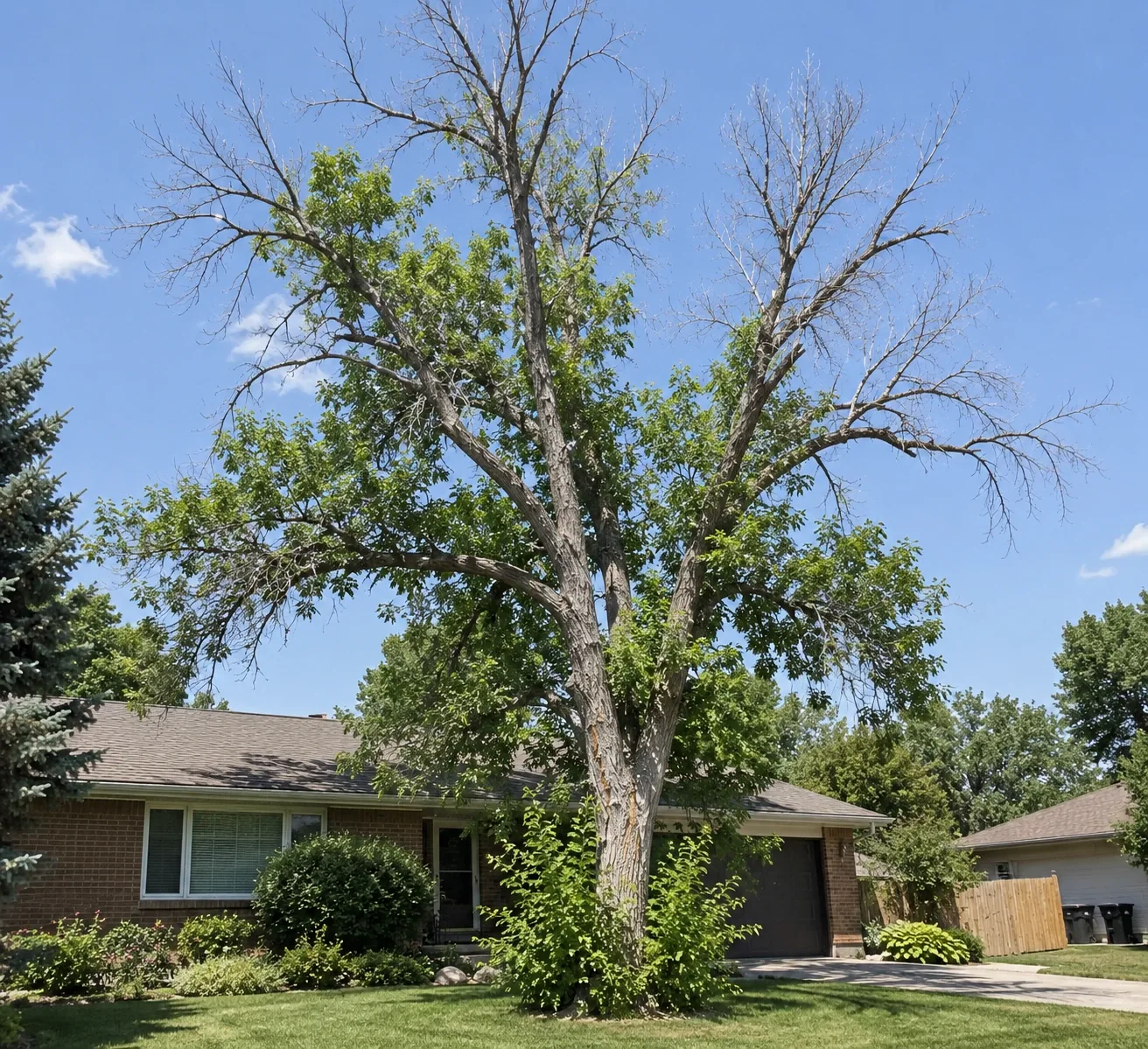
Start at the top and work down
The mistake most people make is inspecting the trunk first. Emerald ash borer damage shows up in the canopy long before anything is visible at eye level, because the larvae sever the tissue carrying water upward and the top of the tree starves first.
No single sign below is conclusive on its own. Two or more together on a confirmed ash is worth a professional inspection.
1. Canopy dieback from the top down
Bare branches in the upper third of the crown while the lower canopy still leafs out normally. Often it starts as thinning rather than obvious death — the top looks sparse against the sky compared with the same tree two summers ago.
This is usually the first visible sign, and it is the one to check in mid-summer when the canopy is fully out. In spring it is easy to mistake late leaf-out for dieback.
2. Sprouting from the trunk and base
Vigorous new shoots erupting straight out of the lower trunk or from the root flare, often in a dense cluster. Arborists call this epicormic growth. The tree is pushing growth below the damaged tissue because it cannot get resources to the top.
On an ash showing canopy dieback at the same time, this is a strong indicator.
3. Woodpecker damage, or blonding
Heavy bark flaking on the upper trunk and larger limbs, exposing pale wood underneath, along with irregular holes. Woodpeckers locate the larvae well before people notice anything, and unusual woodpecker attention on an ash is one of the most reliable early indicators there is.
The giveaway is location: blonding concentrated on the upper trunk and main limbs rather than scattered over the whole tree.
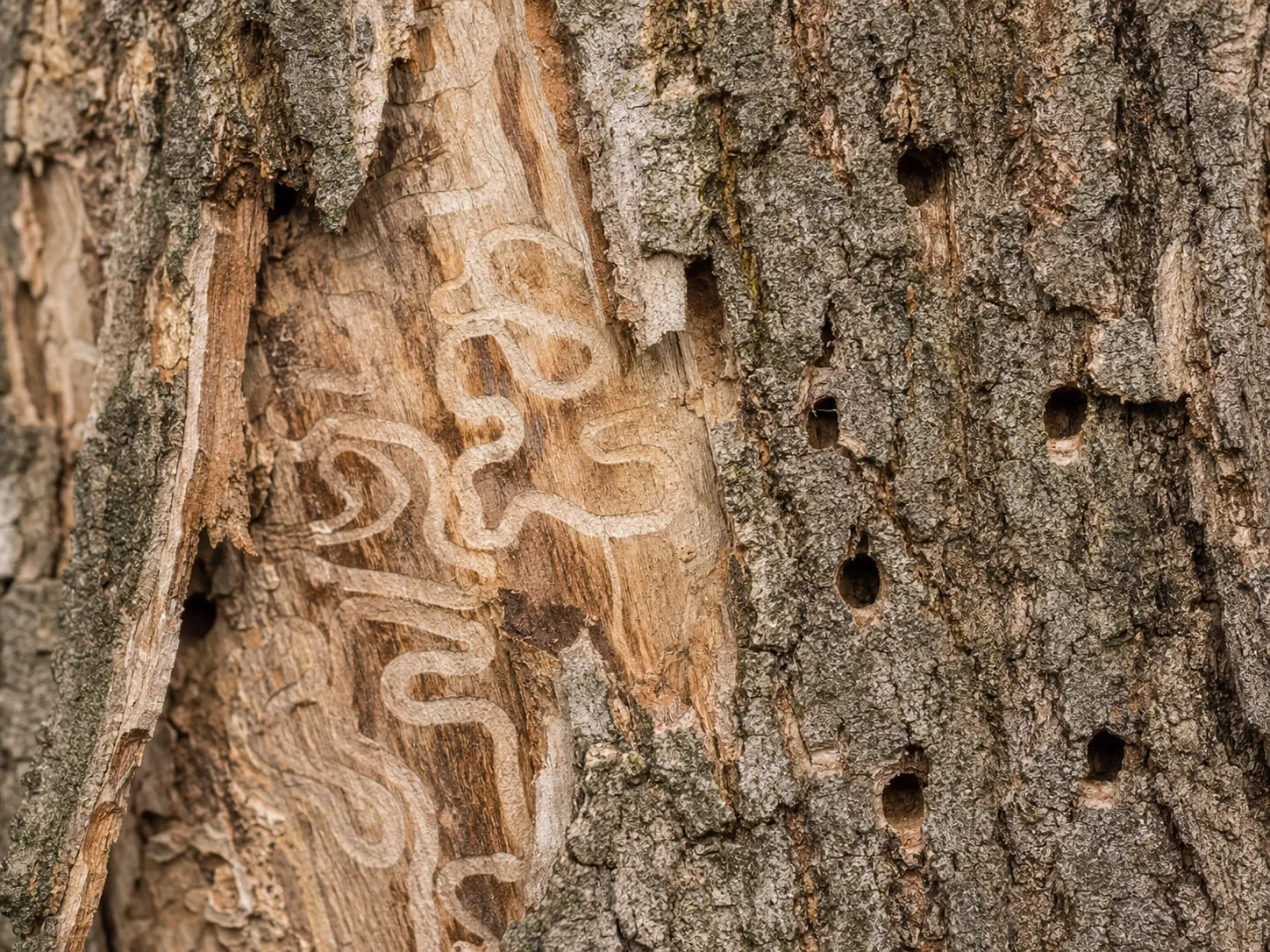
4. D-shaped exit holes
Adult beetles chew their way out through the bark, leaving a hole roughly an eighth of an inch across that is flat on one side — a capital D rather than a circle. Round holes are a different insect entirely.
These are genuinely hard to spot. They are small, they are often high on the trunk, and on rough mature ash bark they disappear into the texture. Absence of visible exit holes proves nothing.
5. S-shaped galleries under the bark
Where bark is loose or has already flaked away, look for winding serpentine tunnels packed with fine sawdust-like frass. The larvae feed back and forth across the grain, which is what produces the distinctive shape and what kills the tree — each gallery cuts the tissue moving water and sugars.
This is definitive. If you can see these, the tree is infested.
6. Bark splitting
Vertical splits in the bark, sometimes with gallery tunnels visible inside the split. Caused by the tree attempting to grow callus tissue over the damage underneath.
Before any of this — is it an ash? Every sign above only means something on a true ash. Ash has opposite branching, compound leaves of five to nine leaflets, and diamond-patterned bark on mature trunks. Mountain ash is a different genus and is unaffected. See how to identify an ash tree.
What else could it be
Plenty of declining ash in Northern Colorado is dealing with something other than EAB, and it is worth ruling these out before removing a tree:
- Drought stress. Thinning canopy and early leaf drop, usually across the whole tree rather than top-down.
- Root damage. Trenching, grading or construction within the root zone in the last few years. The decline often shows up two or three years after the event, by which time nobody connects the two.
- Girdling roots or deep planting. A trunk that enters the ground with no visible flare.
- Lilac-ash borer. A different borer that leaves round exit holes rather than D-shaped, and is far less lethal.
- Ash yellows. Slow decline with tufted foliage and short internodes.
If the picture is ambiguous, an arborist consultation is a cheaper first step than a removal.
What to do if you think you have it
In Greeley, the City asks residents who suspect EAB in their ash trees to contact the Greeley Forestry Program on 970-351-5150. That is worth doing regardless of what you decide about the tree itself, because local detection data shapes how the whole city plans.
Then decide on the tree: treatment if it is a strong candidate, removal if it is not, and this comparison if you are unsure.
Questions we get about this
What is the earliest sign of emerald ash borer?
Thinning or dieback at the top of the canopy, usually visible in mid-summer when the tree is fully leafed out. Woodpecker damage on the upper trunk often shows up around the same time, because woodpeckers find the larvae before people do.
What do D-shaped exit holes look like?
About an eighth of an inch across and flat on one side, like a capital D. Round holes are a different insect. They are small and often high on the trunk, so not seeing any does not mean the tree is clear.
Does woodpecker damage mean my ash has EAB?
Not on its own, but heavy bark flaking and irregular holes concentrated on the upper trunk and main limbs of an ash is one of the more reliable early indicators. Combined with canopy dieback, it is worth an inspection.
My ash is thinning but I see no holes. Is it EAB?
Possibly, and possibly not. Drought stress, root damage from construction, girdling roots and deep planting all produce declining ash in Northern Colorado. Top-down dieback points toward EAB; whole-tree thinning points toward something else.
Can I peel bark off to check?
Where bark is already loose, lifting it to look for serpentine galleries is reasonable. Do not strip sound bark off a tree you intend to keep — that causes real damage on its own.
Who do I report a suspected infestation to?
In Greeley, the City asks residents who suspect EAB to contact the Greeley Forestry Program on 970-351-5150.