Home › Fire Mitigation
Wildfire mitigation and defensible space
Fuel reduction and defensible space work for Weld County properties bordering open grassland and foothills.
Grass fire is the Front Range risk
People picture wildfire as a forest problem, and on the plains east of the foothills it usually is not. The Marshall Fire in December 2021 destroyed more than a thousand homes in suburban Boulder County, driven by grass and wind, in winter, with no forest involved.
Weld County has the same ingredients: cured grass, high winds, and subdivisions built against open ground. If your property backs onto grassland, a greenbelt, a ditch corridor or foothills, defensible space is worth doing.
The zones
Zone 1 — within 5 feet of the structure
The highest-value work, and the cheapest. Nothing flammable against the walls: no woodpiles, no dead shrubs, no juniper, no bark mulch tight to the foundation. Gutters and roof valleys cleared of needles and leaves. Most homes lost in wind-driven fires are ignited by embers landing in exactly these places, not by a wall of flame.
Zone 2 — 5 to 30 feet
Break up continuous fuel. Space tree crowns so fire cannot move directly from one to the next. Remove dead trees and dead limbs. Prune the lower branches off remaining conifers to six to ten feet, which removes the ladder that carries a grass fire up into the canopy. Keep grass mown short through the dry season.
Zone 3 — 30 to 100 feet and beyond
Thinning rather than clearing. Reduce overall fuel density, remove dead and diseased material, and leave a healthier, more widely spaced stand.
Ladder fuels are the thing to understand
A grass fire on flat ground is survivable for most structures. What makes it catastrophic is a continuous path of fuel from the ground into the tree canopy and then to the roof — tall grass into shrubs, shrubs into low branches, low branches into crowns. Break that ladder anywhere and you change the outcome.
That is most of what defensible space work actually consists of: pruning low limbs, removing understory shrubs directly beneath trees, and putting horizontal and vertical space between fuel layers.
Dead ash is fuel. Greeley's emerald ash borer problem and its fire risk are the same problem. Standing dead ash is dry, brittle, and burns readily, and untreated infested ash produces a lot of it in a short time. If you have dead ash within a hundred feet of a structure, it is both a falling hazard and a fuel load.
What the work looks like
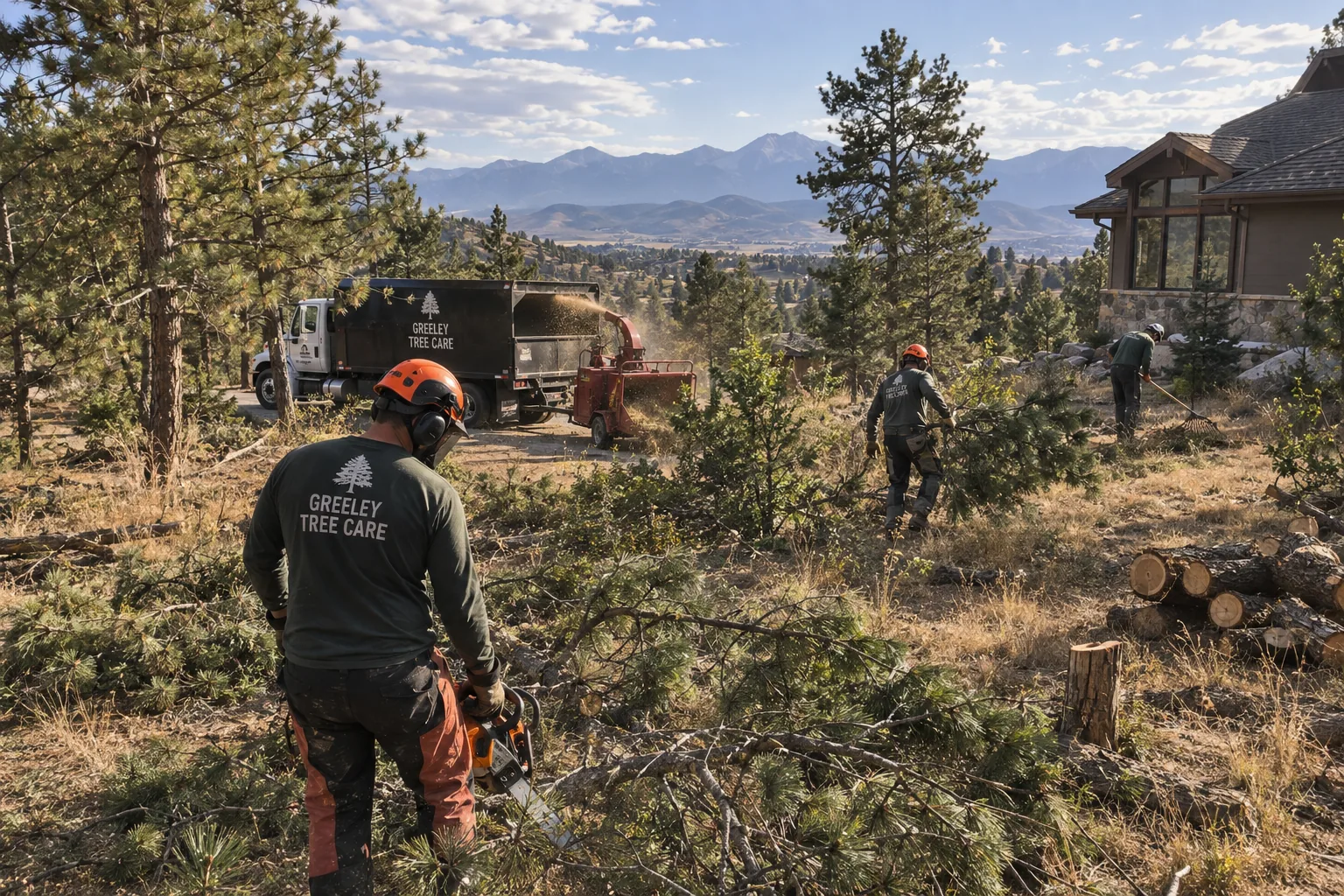
Good mitigation work starts with a walk of the property to identify what actually matters, because there is usually a small number of high-value changes and a long list of things that make little difference. Then: dead and hazardous tree removal, crown spacing, limbing up conifers, understory and shrub clearing, and chipping or hauling the slash.
Slash is the part people forget. A pile of cut brush left on site is a worse fuel load than what you removed. Everything gets chipped or hauled.
Insurance
Colorado insurers have tightened wildfire underwriting significantly, and documented mitigation work increasingly affects both availability and premium. Ask for written scope and before-and-after photographs — that is what carriers want to see.
Questions we get about this
Does Greeley itself need defensible space work?
Inside the built-up city, less so. It matters for properties on the edge of town backing onto open grassland, ditch corridors or greenbelts, for acreages in Weld County, and for anything in the foothills. If open cured grass runs up to your fence line, it is worth a look.
What is a ladder fuel?
Any vegetation that carries fire vertically from the ground into the tree canopy. Tall grass into shrubs into low branches. Removing lower limbs and clearing shrubs directly beneath trees breaks that chain.
How far should I clear around the house?
Zone 1, the first five feet, matters most and is where the cheapest improvements are. Zone 2 out to thirty feet is about breaking up continuous fuel rather than clearing everything. Beyond thirty feet you are thinning, not removing.
Will this lower my insurance?
It can affect both availability and pricing, and Colorado carriers have tightened wildfire underwriting considerably. We provide written scope and photographs so you have documentation to submit.
Do you haul away what you cut?
Always. Cut brush left on site is a worse fuel load than the standing vegetation was. Everything is chipped or hauled off.